
80 Years of HANNOVER MESSE - Episode 2
A World Trade Fair with an Attic—How the HANNOVER MESSE Grew in the 1960s and Learned to Let Go in the 1970s (1960–1979)
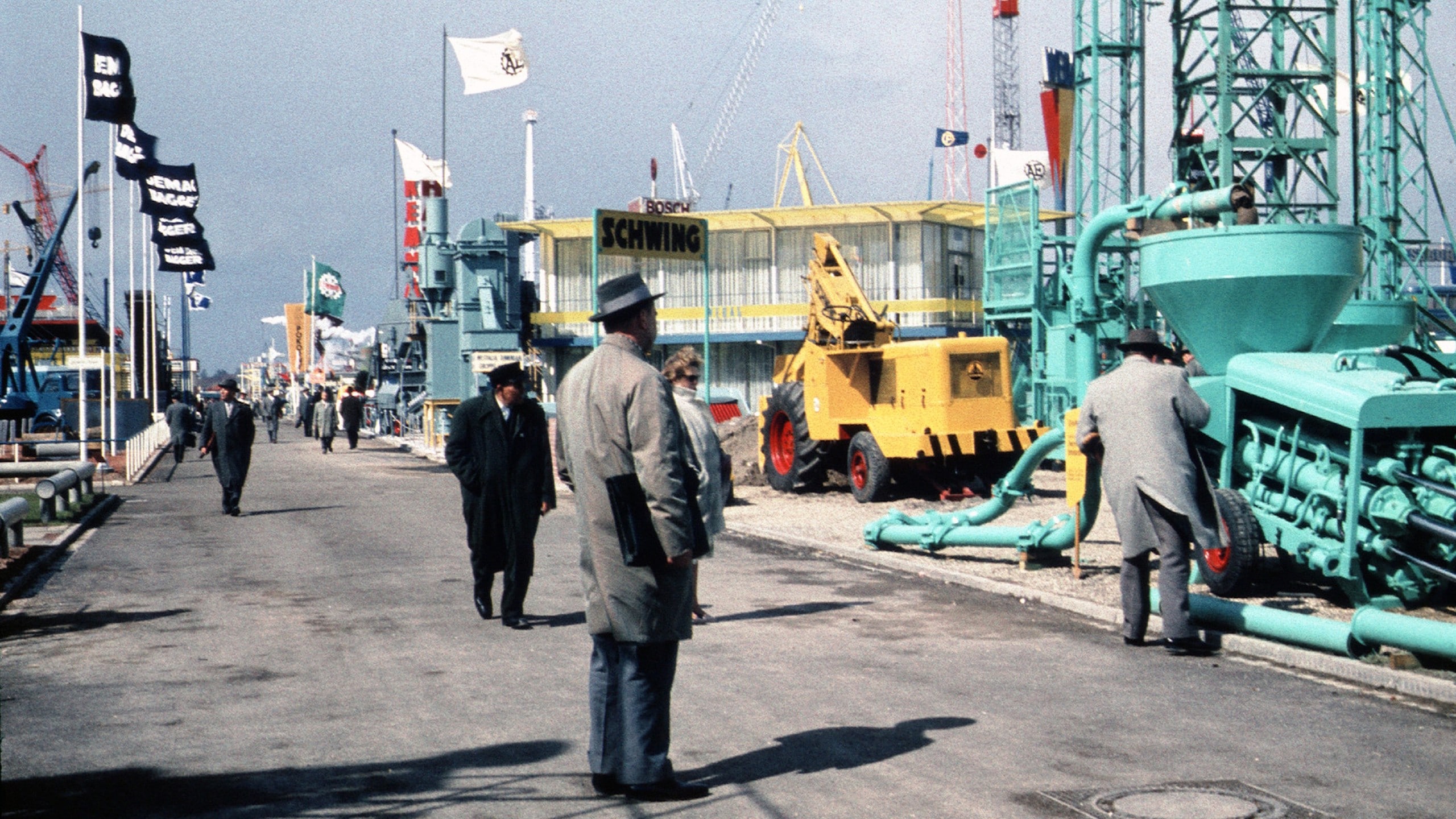
A small plane in front of the entrance, a forklift without a clutch, 750 bungalows on the roof of a hall—and then a crisis that cost the trade show nearly a third of its exhibitors within two years. In the 1960s and 1970s, HANNOVER MESSE demonstrated twice what it was capable of: first, the power to grow; then, the art of adapting.
Landing strip in front of Entrance West 1—in the spring of 1965, you could still fly right into the trade fair. Those who could afford it landed their small planes right at the gates of the industrial exhibition. Everyone else looked for a place to stay—and found it with the “trade show moms,” those private families who shared their bathrooms and kitchen tables with their guests because the hotels were long since unable to accommodate everyone. As early as the beginning of the 1960s, according to the trade show’s chronicle, more than a million visitors came year after year.

The German Industrial Fair Becomes HANNOVER MESSE
Since 1961, the show has borne the name by which the world knows it: The German Industrial Fair became the Hannover Messe—at that time, still with a hyphen. Exhibitors set up long-term operations; lease agreements of up to ten years are not uncommon. The largest sector is mechanical engineering, followed by the electrical industry; office equipment ranks third but is growing even faster than it did in the 1950s.
Hanover Receives Its Seal of Approval
From April 24 to May 2, 1965, Hanover received its seal of approval. “Hanover has finally become a world’s fair,” wrote Diether Stolze in the May 7 issue of *Die Zeit*. More than one million visitors had come from 105 countries, including three Soviet ministers. The chemical, electrical, and television industries secured major contracts, with office equipment and electronics leading the way. Special exhibitions—with Siemens particularly standing out—and daily television reports drew in the general public. By 1969, the exhibition booths covered 418,000 square meters; even the economic slump of 1966–67 had long since been overcome.


Outdoors: Forklifts, Dump Trucks, Cranes
The trade show’s largest showcase has no roof. Cranes, excavators, tractors, and trucks are on display in the outdoor area—the weekly newsreel captures the scene time and again. The vehicles arriving here are transforming factory floors and construction sites. In 1960, Linde unveiled the Hubtrac at the industrial trade show—the first forklift with hydrostatic drive, in which oil pressure replaces the clutch and manual transmission. That same year, Festo made its debut with its own pneumatics booth. And in 1966, the Rheinstahl Group unhesitatingly placed a Henschel tipper semi-trailer on stilts—more precisely, on a movable elevated steel road. “Particularly attractive,” judged the editor of the trade journal *lastauto omnibus*.
Partner Country Without a Title: Pipes, Ministers, a Luncheon
HANNOVER MESSE did not have an official partner country until 1980. Until then, the entire world was simply a guest—from both sides of the Iron Curtain. In 1965, Hall 17 even featured calculating machines from the GDR—Ascota, Optimatic, Soemtron—exhibited by West German distributors. In 1966—according to historian Manfred Wilke’s account—a Soviet delegation at the fair offered Ernst Wolf Mommsen, head of Thyssen-Röhrenwerke, cooperation on pipe deliveries for their pipelines.
One of the biggest East-West deals of the era
Three years later, it became a major political issue. As historian Susanne Schattenberg describes, in April 1969, Federal Minister of Economics Karl Schiller dined with Soviet Minister of Foreign Trade Nikolai Patolitschev in the “Lüneburg” lounge of the Intercontinental Hotel; afterward, the two drove to the trade fair in Schiller’s official car. During the tour, Mommsen promotes his products: “You can only get the 2.50-meter pipes from us.” Schiller quips that the man simply has a monopoly on them; Patolitschew comes to the salesman’s defense: “But he’s absolutely right.” On February 1, 1970, the agreement is signed in Essen. The contract exchanges 1.2 million metric tons of large-diameter pipes from Mannesmann and Thyssen for Soviet natural gas over a twenty-year period. One of the largest East-West deals of the era got its start at the trade fair grounds.
First official partner country: Brazil
This international flair persists, even as times grow tougher. In 1975, more than one in five exhibitors comes from abroad, and for 1978, the Soviet Union announces that it will once again exhibit on a large scale—covering around 2,000 square meters—with a central booth in the outdoor area and capital goods from mechanical engineering, energy technology, and vehicle manufacturing. In 1980, the trade fair invited a country to serve as a partner for the first time: Brazil. It returned in 2026, and in his opening speech, Federal Chancellor Friedrich Merz recalled the premiere in 1980.

A 556-page catalog and a machine from Paderborn
Anyone wanting to study the list of exhibitors in 1965 will need patience: The first volume of the trade show catalog alone has 556 pages. Those who want to see computers should head to Hall 17 in the northeast corner of the grounds—a three-story building and the largest of the 25 exhibition halls. On the ground floor, IBM, Bull, Remington Rand, Zuse, Electrologica from the Netherlands, and ICT from England are all crammed together. One floor up are calculating and bookkeeping machines ranging from Addiator to Monroe, a whole arsenal of slide rules—and an adding machine from America whose manufacturer would later make a name for itself with entirely different computers: Commodore.

Meanwhile, at the Wanderer-Werke booth in Cologne, there is a device whose developer does not have a booth of his own. Heinz Nixdorf from Paderborn is showcasing a transistor-based minicomputer here, which Wanderer markets under the name “Logatronic.” He aims to bring computing power to where the work is done—to the workplaces of small and medium-sized businesses, far from the data centers of large corporations. The market proves him right. The company Ruf places a single order for 2,000 units worth around 40 million marks, and Nixdorf’s revenue climbs from 28 million marks in 1966 to more than 100 million in 1968. That same year, he takes over Wanderer-Werke entirely. In 1969, Nixdorf Computer AG has its own stand in Hannover. He arrived as a subtenant and returned as the owner.

CeBOT or CeBIT?
Meanwhile, Hall 17 is bursting at the seams. In two meetings—on December 12, 1968, and February 14, 1969—the supervisory board of Deutsche Messe- und Ausstellungs-AG approves 24 million marks for an electronics building and 58.8 million for a massive office technology hall. In a design drawing by architect Ernst Friedrich Brockmann, the new building is simply labeled “Halle 17 neu” (New Hall 17). The Exhibitor Advisory Board chooses the final name by a narrow majority: “Centrum der Büro- und Informationstechnik” (Center for Office and Information Technology), or CeBIT for short. By a hair’s breadth, “Organisationstechnik” (Organizational Technology) would have prevailed, and the world would later have made a pilgrimage to CeBOT.

Sleeping on the Roof of the World’s Largest Exhibition Hall
The new Hall 1, which was the world’s largest exhibition hall when it opened, offers 52,000 square meters of exhibit space. Its gross area is roughly the size of ten soccer fields, and the basement has parking for 2,000 cars. Parking spaces were actually supposed to be built on the roof as well. Trade fair director Ernst Pätzold has a better idea: 1,000 bungalows where exhibitors can spend the night and, well-rested in the morning, take the elevator down to their own booths—but please, in a way that doesn’t make it look like a shantytown. A total of 750 hexagonal “Trelemente” are erected based on Brockmann’s design. Siemens secures a good dozen of them—not for sleeping, but to host its most important clients there. The residential honeycombs inspire numerous, mostly risqué jokes. More enduring than the jokes, however, are the ownership arrangements. Exhibitors can literally buy their way into Hall 1, and even decades later, some of them still own parts of the building.
Computers alongside Experimental Race Cars
On April 25, 1970, Chancellor Willy Brandt opened the trade show and took a tour of “CeBIT”—using the neuter form, as was customary at the time. 285 information technology manufacturers occupied 64 percent of the exhibition space, led by Olympia Werke from Wilhelmshaven with its Multiplex 80 data acquisition system; the remainder was shared by 350 office equipment suppliers. A total of 5,531 companies exhibited that year, with one in five coming from abroad. Computers alone apparently weren’t enough to fill a booth: in the early 1970s, IBM displayed an experimental race car from Daimler-Benz alongside its exhibits.

Car-Free Sundays, Empty Halls
Then the mood takes a turn. In the fall of 1973, oil-producing countries cut back on their supplies, and the federal government, under the Energy Security Act, imposed a driving ban on four Sundays, beginning on November 25. Within two years, the number of unemployed rose from 273,000 to more than one million. The trade fair saw this turnaround reflected in its own statistics: 5,792 companies exhibited in 1973; in 1974, the number dropped to 4,716; and by 1975, it had fallen to just 4,028. Two halls remained empty in 1975; by 1978, the number had risen to four. It wasn’t until 1983 that the 1973 level was reached again.
Loyalty Endures
In 1976, at the 30th Hannover Messe, Siemens Executive Board member Ulrich Haier captured the mood of those years: “Our situation hasn’t improved yet—but our spirits have.” On May 1, the trade fair parking lots were, for once, filled to capacity with 50,000 vehicles. And loyalty remained strong. “We’ve participated 25 times in a row and received a certificate for it,” the office equipment manufacturer NCR reported in 1975, not without pride.

Processes of Separation in the 1970s
In 1975, *Computerwoche* cited three reasons for the decline: the economic climate, costs—and independent trade shows. The third reason takes us right to the heart of the matter, because during those years, the trade show began to offload what no longer had a place under its roof. Construction equipment manufacturers joined the Bauma trade show in Munich; as early as 1973, part of the outdoor exhibition area remained unoccupied. Office furniture manufacturers, who refused to be relocated to another hall, bid farewell to CeBIT in the summer of 1974 and began meeting at the Orgatechnik trade show in Cologne from then on. In 1975, LIGNA broke away because woodworking and forestry machinery simply required too much space; it remains the leading trade show in its industry to this day.
On the Way to the Eighth Day
The trade show also parts ways with its less industry-oriented sectors. The consumer goods exhibition Interfachmesse, launched in 1974, gets off to a promising start with 900 exhibitors, but first the visitors stay away, then the companies—by 1975, the number has dropped to 740. In 1978, porcelain, jewelry, and gift items disappear from the industrial trade show for good. What looks like decline is actually consolidation. As late as the 1970s, the trade fair covered 29 subject areas; thereafter, it consolidated its offerings into ten specialized trade fairs under one roof. In 1979, it was also shortened to eight days.

The microcomputer is coming—with a six-week lead time
Of all times, it’s during the slump that space is running short under the roof of the exhibition complex. In 1975, minicomputer manufacturers Data General, Interdata, and Texas Instruments made their debut in Hanover. Ten days before the 1978 opening, Hall 1 was still a yawning void. Of more than 650 exhibitors, Hall Manager Kurt Merk knows, only 100 are setting up. But then *Computerwoche* reports a huge crowd at Commodore. There stands the PET 2001, a desktop computer with BASIC for 2,900 marks, with a delivery time of no more than six weeks—presumably the first appearance of a microcomputer at CeBIT. Thirteen years earlier, the same company had exhibited an adding machine in Hall 17.
The “daughter” is ready to move out
In 1979, Hall 2 is added; the trade show promotes itself with the slogan “CeBIT now to the power of three.” The software section, which until then had been located on the roof of Hall 1, moves to Hall 18—with the exception of two exhibitors—and the area grows from 79,000 to 91,000 square meters of booth space. The “daughter” is ready to move out: in 1986, the trade show section becomes the independent CeBIT.
A Trade Show on Wheels for Decades
Anyone who has exhibited over the decades—and continues to do so today—is familiar with both the highs and the lows. Festo, based in Esslingen and a family-owned business since 1925, has been listed in the HANNOVER MESSE exhibitor directory since 1949, according to its own history. Kurt Stoll, son of the company’s founder, introduced pneumatics in 1950 after attending a trade fair in Chicago; the first pneumatics catalog from 1956 listed 166 items, whereas today there are around 33,000 catalog products. In 1962, the company headquarters—still in use today—was built in Esslingen-Berkheim; in 1965, Festo Didactic was established as a separate division dedicated to learning systems and seminars—promoting lifelong learning long before anyone was talking about a shortage of skilled workers.
In 1974, one year after the oil crisis, Festo put its trade show on wheels: The Expotainer M1 is a mobile trade show booth equipped with 16 displays, air conditioning, and a coffee machine. In 1978, it crossed the Atlantic for the first time. The stories from these tours have become company legend. In the 1980s, the Expotainer was stuck in front of a tunnel in South America that only allowed vehicles up to 3.80 meters in height—it measured 3.95. The driver, traveling in one of the first air-suspension trucks, unloaded the trailers, deflated the system, guided the containers through the tunnel one by one, and then reinflated them. A pneumatic manufacturer solves his problem—with air, of course.
The “Incredible Machine” and Milestones in the History of Automation
A good half-century after the first Expotainer, Festo arrived in Hanover in 2025 with a machine that produces nothing yet sets a great deal in motion. To mark its 100th anniversary, the company had built an “Incredible Machine”—a chain reaction based on the Rube Goldberg machine principle, in which one impulse triggers the next. The impetus comes from an artificial butterfly, the eMotionButterfly, and each subsequent station represents a flutter of wings in the history of automation, all the way to the drive technology of tomorrow. The butterfly effect—this time, by design. During the traditional opening tour on March 31, 2025, German Chancellor Olaf Scholz watched a demonstration of the machine in Hall 7 and offered his congratulations on the company’s centennial. He was accompanied by Lower Saxony’s Minister President Stephan Weil and Stéphane Dion, the Special Envoy of partner country Canada to the European Union. Festo CEO Thomas Böck shared a forecast with the guests that was fitting for such an anniversary: The company is “looking optimistically toward the current fiscal year and the next 100 years.”
The Long Road from Terminal Blocks to the DC Grid
Phoenix Contact, also a family-owned business, has counted HANNOVER MESSE among the highlights of its year for more than 70 years. The company grew out of an idea from 1928. An engineer from the energy provider RWE told Hugo Knümann, a businessman from Essen, about ten-pole terminal blocks made of ceramic that were virtually impossible to customize as a single unit. Knümann promptly disassembled them into individual terminals and mounted them in a row on a mounting rail—and the terminal block was born. After Knümann’s death in 1953, former Siemens engineer Josef Eisert and long-time authorized signatory Ursula Lampmann transformed the trading firm into a manufacturer with its own production facility in Blomberg, in the Lippe region. In the 1960s and 1970s, the next generation of the Eisert family took over.
Transformed to Endure
In 2026, German Chancellor Friedrich Merz and Brazilian President Luiz Inácio Lula da Silva stopped by the booth and spoke with CEO Dirk Görlitzer about direct current (DC) grids. It’s a long way from the terminal block to the DC grid; in Hanover, visitors can see this evolution year after year. The trade show knows the value of such loyal participants. They have all stayed because they have evolved.
Today and Tomorrow: From the Oil Shock to Energy Week
These two decades have left behind more than just a treasure trove of anecdotes. Hall 1, which began as a “computer village” with a rooftop settlement, partially resumed operations in 2013 for HANNOVER MESSE. CeBIT, which emerged from it, ended in 2018, but its industry-related digital themes live on stronger than ever at HANNOVER MESSE. Nixdorf’s idea of bringing computing power to where the work is done has become part of everyday life. So has learning, which Festo turned into a business segment in 1965.
The oil crisis also continues to have an impact as an ongoing challenge. Energy has remained a core issue for industry. Today, Festo offers TÜV-certified energy efficiency audits for compressed air systems, and in 2027, the topic will have its own dedicated event when the new Europe Energy Week launches in parallel with the HANNOVER MESSE. From April 5 to 8, 2027, the trade fair will celebrate its 80th anniversary, with Spain as the partner country and, for the first time, spanning four days—focused on the days with the highest visitor turnout. This, too, is a tradition. The event was shortened as early as 1979, and five years later, the trade fair earned eight entries in the Guinness Book of World Records.
Building a Stage for Industrial Change
The 1960s taught the trade show to grow; the 1970s taught it to let go. Together, these two decades have shaped its business model to this day: building a stage for industrial change and remodeling it as soon as the play changes. The bungalows on the hall roof were a brainchild of their time. The principle behind them has endured: Wherever industry reinvents itself, the trade fair creates space—on the roof, if necessary. The next episode tells the story of what happens when the “daughter” moves out.
More Episodes
80 Years of HANNOVER MESSE - Episode 1 (1947–1959)
Peas, fish sandwiches, and a patron god with a winged helmet—as HANNOVER MESSE began its journey to becoming the world’s most important industrial event.