
A thousand qubits for the next quantum leap
A consortium led by the Physikalisch-Technische Bundesanstalt (PTB) is developing an ion-trap quantum computer with at least 1,000 qubits. The five-year project aims to lay the foundation for commercially viable quantum computers.
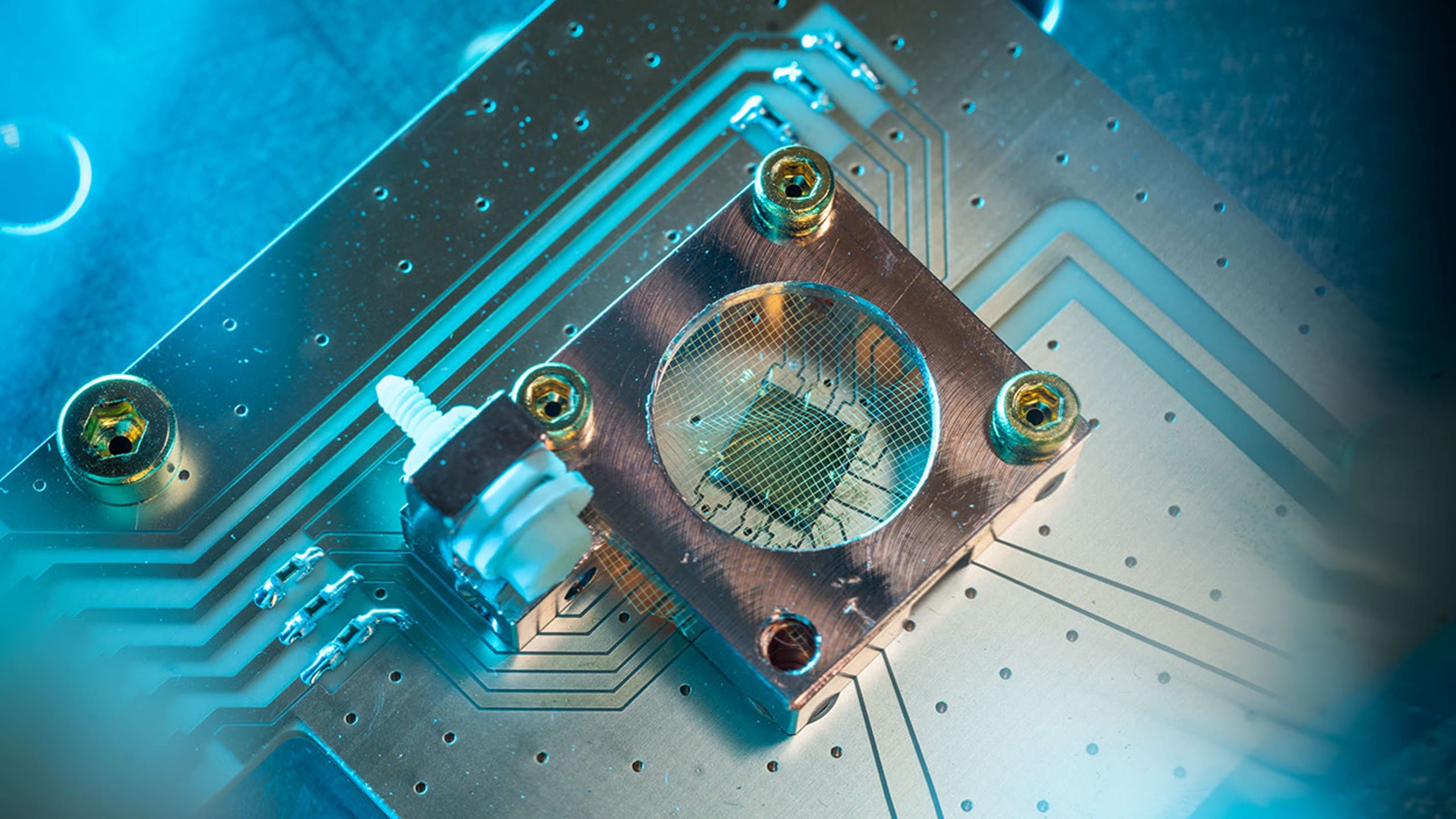
By 2030, the German federal government aims to establish at least two error-corrected quantum computers at the cutting edge of European technology. To this end, the Federal Ministry of Research, Technology, and Space (BMFTR) is investing 640 million euros as part of the Quantum Computing Competition. Six consortia led by German startups have reached the next phase of the competition—and the Physikalisch-Technische Bundesanstalt (PTB) plays a key role in one of them. The project is called NFQC-1k, has a total budget of 122 million euros, and pursues a clear goal: to build a commercially viable quantum computer with at least 1,000 qubits—based on ion trap technology.
A consortium that brings together science and industry
The NFQC-1k consortium covers the entire technology chain: from basic research to technology development by visionary startups, all the way to the expertise of an established semiconductor manufacturer. The consortium leader—and thus responsible for the development and integration of the entire system—is QUDORA Technologies, a globally active manufacturer of quantum processors. The company brings together the expertise of the seven participating German research and industry partners, whose contributions complement one another at the highest scientific level. The PTB will primarily contribute its expertise in benchmarking logical operations (gates), in the field of quantum algorithms, and from its research on ion traps. Much of this scientific know-how was developed in the predecessor project ATIQ and builds on the foundations laid in the Quantum Frontiers Cluster of Excellence and the Collaborative Research Center DQ-mat.
Most of the consortium partners are members of Quantum Valley Lower Saxony (QVLS), Lower Saxony’s hub for quantum technology, and have jointly fostered an outstanding quantum ecosystem in the region over the past few years. Within this environment, the technology for a 50-qubit quantum computer demonstrator has already been developed as part of the QVLS-Q1 project. QVLS views the invitation to submit a full proposal as proof of the successful development of this ecosystem: from long-term funded cutting-edge research and infrastructure, through proprietary technology platforms and spin-offs, to industrial and international scaling.
In addition to the Physikalisch-Technische Bundesanstalt (PTB), the NFQC-1k consortium includes the following members: QUDORA Technologies, the Technical University of Braunschweig (TUBS), Leibniz University Hannover (LUH), NXP Semiconductors Germany GmbH, Forschungszentrum Jülich, and AQT Germany GmbH.
What NFQC-1k is intended to achieve
NFQC-1k is not intended to be merely a laboratory system, but rather a system that can be commercially utilized in Germany and Europe in the long term. Its name is derived from Qudora’s proprietary Near Field Quantum Control (NFQC) technology. It combines precise qubit control, exceptionally long coherence times, and semiconductor-compatible fabrication to increase performance per qubit. The goal of the NFQC-1k project is to build a quantum computer demonstrator with at least 1,000 controllable physical qubits and at least 50 logical qubits, with a logical error rate of less than 0.01 percent for logical gate operations.
Funding Framework and Next Steps
The funding is structured for up to five years and is part of the BMFTR research program “Quantum Systems.” All consortia in the competition will soon face their next review: By March 31, 2027, at the latest, they must demonstrate that their systems meet the technical entry criteria. These criteria include, among other things, functional hardware with at least 24 controllable qubits and high computational accuracy (two-qubit gate fidelity of at least 99.5 percent).