
E-scooters get stationary storage systems rolling
EDENenergy, a spin-off of the Fraunhofer Institute for Solar Energy Systems ISE in Freiburg, develops and sells stationary storage systems made from old e-scooters. The capacity is guaranteed for ten years without any loss.
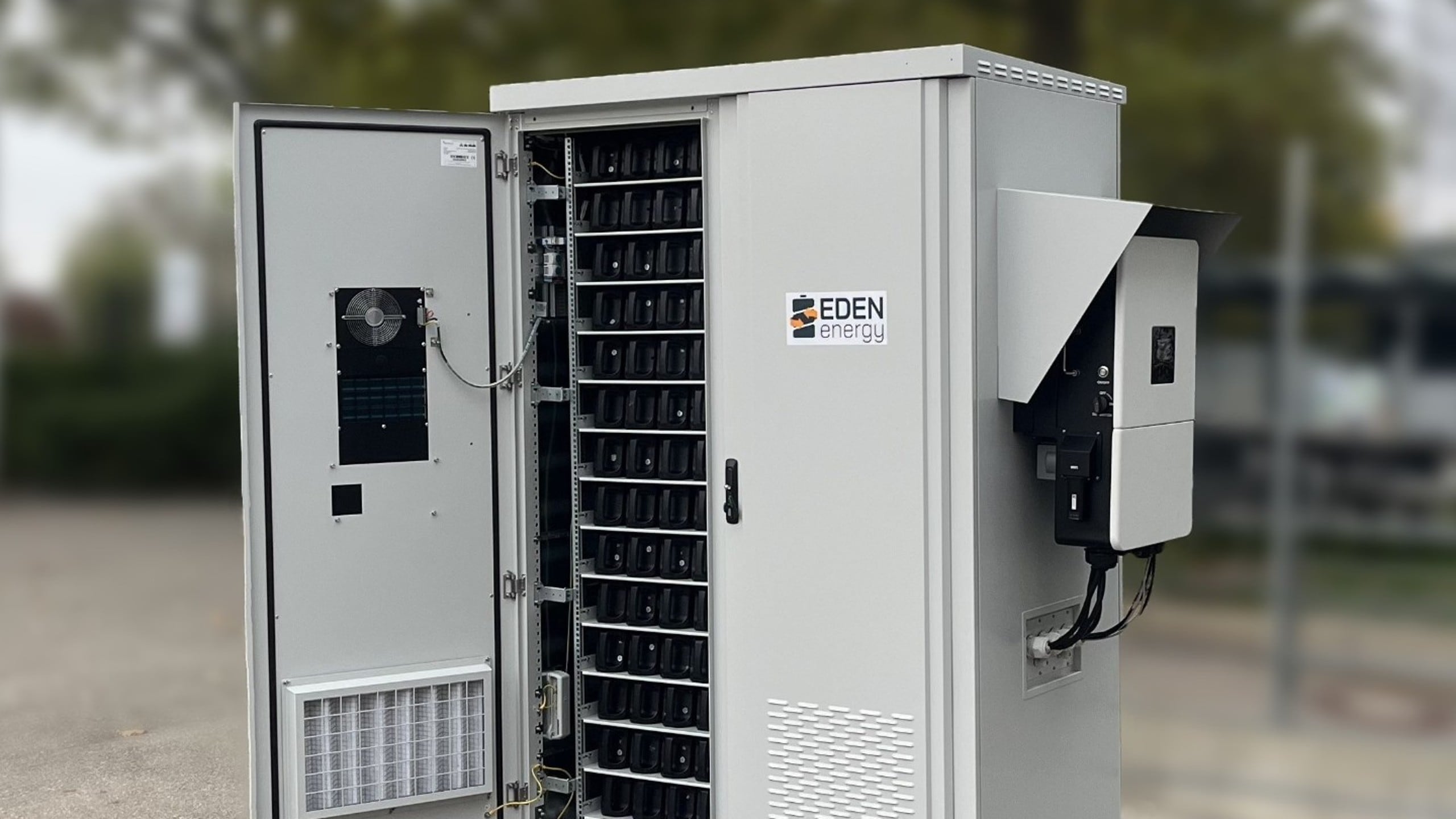
In Germany alone, about one million high-performance batteries from e-bikes or scooters end up in the trash prematurely every year, even though they often still retain a large portion of their capacity. At the same time, stationary energy storage systems are expensive and resource-intensive to manufacture. The Freiburg-based startup EDENenergy aims to solve both problems: It is developing modular industrial storage systems made from second-life batteries that are high-performance, cost-effective, and sustainable. The former scientists from the Fraunhofer Institute for Solar Energy Systems (ISE) are relying on a system with interchangeable battery modules and flexible power electronics that efficiently and safely combine heterogeneous batteries in stationary storage systems.
In the field of automotive batteries, “second-life” concepts have already demonstrated how valuable used energy storage devices can be. The potential of micromobility—that is, the millions of e-bikes and e-scooters, an increasing number of which are being returned—has not yet been tapped. This is due to the enormous variety of batteries—designs, cell types, energy management systems—which make standardized reuse difficult. This is where the startup EDENenergy comes in with power electronics developed at Fraunhofer ISE: “It allows different storage units to be connected and enables communication with various modules without having to disassemble the batteries,” explains Florian Bierwirth, who, like his co-founders Daniel Seeger and Hannes Kurzmann, previously worked in the Power Electronics Department at Fraunhofer ISE.
From E-Bikes to Industrial Applications
For its market entry, the startup is focusing on industrial storage systems with a capacity of 70 kilowatt-hours. “In mid-October, we delivered the first storage system to a customer, which was an important milestone for our young company. With this storage size, we initially aim to target medium-sized companies in the region that have a photovoltaic system but do not yet have a storage solution.” The storage systems could also be of interest to municipal utilities, which can use them to optimize self-consumption, shave off peak loads, or for electricity trading. For the first industrial storage system, 112 end-of-life e-scooter batteries—after being thoroughly tested in an initial screening—are interconnected. Currently, EDENenergy relies on large suppliers (such as fleet operators of e-bikes and e-scooters), which ensures that enough batteries of the same type can be used for now. Looking ahead, the innovative power electronics will also allow different types of batteries to be interconnected. “To do this, the connector interfaces, battery management system, and communication protocols must be adapted for each new battery. There’s a particularly wide range of options when it comes to e-bikes,” says Florian Bierwirth, outlining the challenge. In the long term, standardized communication protocols for battery storage systems and “second-life” legislation governing the use of mobile batteries in stationary applications will be necessary.
Battery modules can be replaced individually as needed
The first 350 batteries tested held a pleasant surprise for the three young entrepreneurs: they were in significantly better condition than expected. While EDENenergy had calculated a remaining capacity (“State of Health”) of 80 percent for second-life batteries, the used batteries actually had an average remaining capacity that in some cases was well over 90 percent. In stationary storage systems, where—unlike in their first life—they are exposed to fewer vibrations or temperature fluctuations, these batteries can continue to perform well for several more years. EDENenergy remotely monitors the battery modules via a monitoring system. When they reach the end of their service life, the battery modules are replaced individually, which can even be done while the battery system is still in operation. The batteries that are finally at the end of their useful life are then sent to partner companies for recycling. Compared to standard energy storage systems on the market, this turns an apparent disadvantage into a technical advantage: replacing individual modules makes it possible to maintain the storage system’s capacity at a constant 70 kilowatt-hours even after ten years. Due to battery degradation, conventional manufacturers typically guarantee only 80 percent of the original capacity after ten years.
In the next steps, the young company—which now employs three part-time staff members in addition to the three founders—aims to expand the size of the storage systems up to 300 kilowatt-hours. They are also seeking additional pilot customers among regional commercial businesses, which can receive 50 percent funding for the storage system through the state grant program “Mittelstand trifft Startups,” which has already been approved. EDENenergy also receives funding from the Center of Excellence for Sustainability and through the state grant program for innovative startups “BW Pre-Seed,” under which JobRad founder Ulrich Prediger is the company’s first investor.