
Humanoids on Probation
A 96 percent success rate at Mercedes-Benz, up to 1,000 robots for GXO, test sites at GlobalFoundries and in E.ON’s power grid: Humanoids are moving closer to real-world processes. However, the details reveal just how many challenges still lie between pilot projects and full-scale operation—and who sets the terms.
On November 10, Google DeepMind unveiled Gemini Robotics 2.5, a vision-language-action model that translates camera images and voice commands into arm and hand movements. According to the company, in more than 200 laboratory tasks, the success rate was 30 to 100 percent higher than that of its predecessor, depending on the task type, and execution was 20 to 30 percent faster.
The Last Four Percent
The most practical figure comes from a proof of concept with Apptronik and Mercedes-Benz: At the Kecskemét and Sindelfingen plants, the Apollo 2 humanoid robot retrieved metal brackets from bulk containers on running assembly lines and sorted them into sequence containers in vehicle order. The success rate was 96 percent.
That’s impressive, yet still insufficient for a mass-production process: Ars Technica notes that a human would almost always perform such routine work correctly. DeepMind Director Kanishka Rao told Ars Technica that closing the remaining gap would be a “steep climb.” Furthermore, the model runs on cloud servers—which introduces latency—and is currently available only to robotics partners. To ensure security, DeepMind released the open benchmark ASIMOV-Jailbreak, which includes 1,500 test instructions designed to disguise unsafe commands. According to DeepMind, Gemini 4 Argon resists such attempts 99.5 percent of the time, while the previous reference model achieved 82 percent.
Memorandum of Understanding with Performance Metrics
GXO demonstrates how users can commercially mitigate this vulnerability. The contract logistics provider signed a non-binding memorandum of understanding with Apptronik on November 12. According to the agreement, testing is set to begin in 2027; over four years, up to 1,000 Apollo robots could be deployed—provided that agreed-upon performance metrics are met. The first deployment is scheduled for late 2027 in North America, and billing will be based on the “Robot-as-a-Service” model. The figure of 1,000 is therefore an upper limit, not a firm order.
From Four Legs to Two
GlobalFoundries is taking a similarly phased approach. On November 17, the semiconductor manufacturer and Boston Dynamics announced plans to deploy the Spot inspection robot at their fabs in Malta (New York), Burlington (Vermont), Dresden, and Singapore. In Singapore, two Spot robots have covered approximately 900 kilometers in the supply levels beneath the cleanroom production areas since April and completed more than 90,000 inspections, with a mission success rate of 99 percent. Spot has enabled the shift from reactive to predictive maintenance, says Pradip Singh, Chief Manufacturing Officer at GlobalFoundries. In addition, the company is the first customer outside the automotive industry to join the early-adopter program for the humanoid Atlas. On-site testing is scheduled to begin in early 2027; specific tasks, unit numbers, or conditions have not yet been disclosed.
The Power Grid as a Training Ground
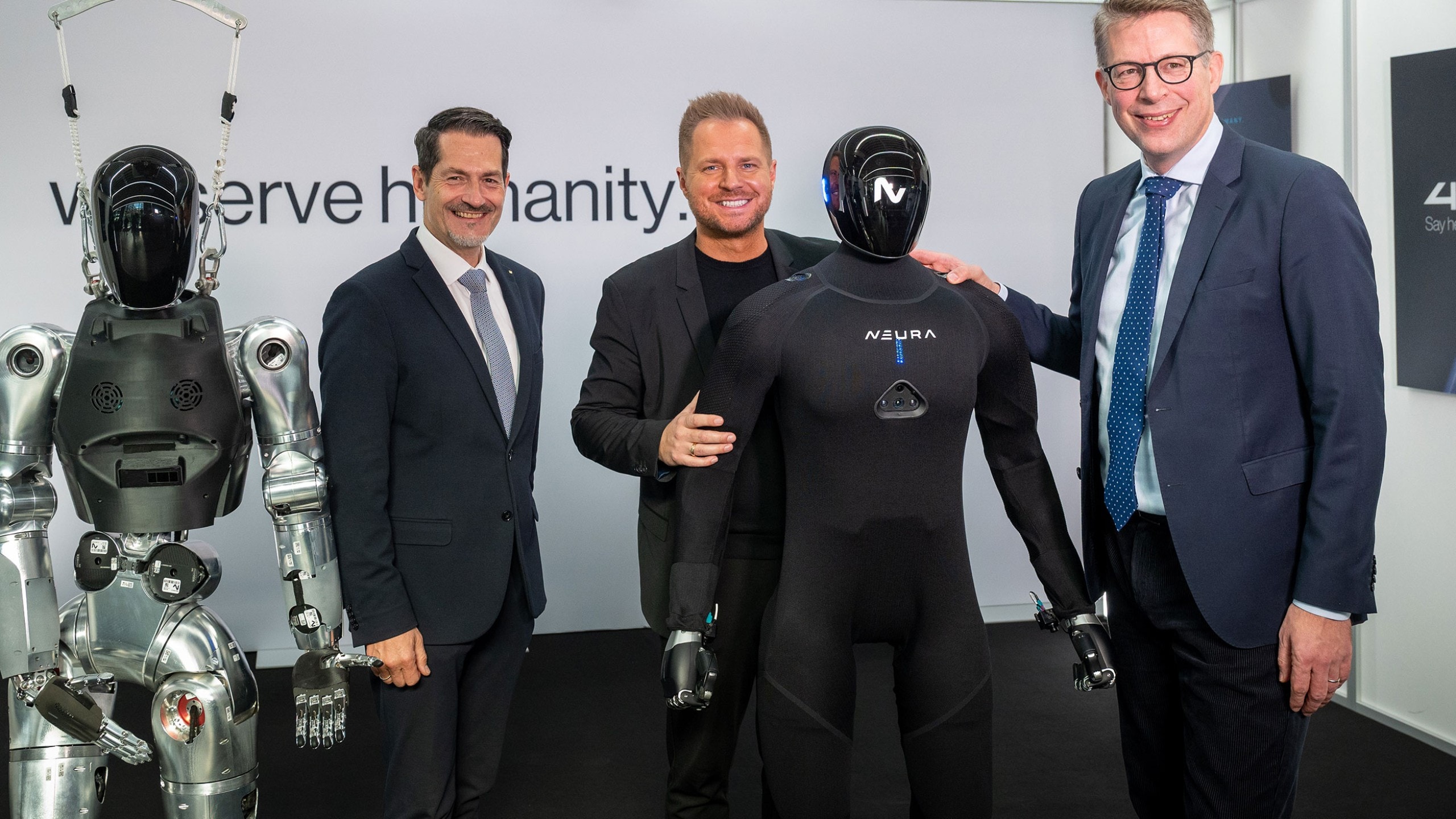
In Germany, NEURA Robotics, E.ON, and enviaM are preparing humanoid robots for grid operations. In early November, the partners announced plans to develop applications for inspections, the monitoring of critical infrastructure, and the support of skilled workers in physically demanding or hazardous tasks. Training takes place at the TUM RoboGym—a 2,300-square-meter facility opened by NEURA and the Technical University of Munich at Munich Airport—using a combination of human demonstrations, data from real-world robot deployments, and simulation. The pilot partner is Mitnetz Strom, a subsidiary of enviaM, which plans to gain its first practical experience in 2027. “Humanoid robots can specifically relieve their workload,” said enviaM CEO Stephan Lowis, referring to the employees.
Stress Test in a Retail Store
AGIBOT demonstrated just how insightful a test under real-world conditions can be. Six G2-type robots worked for 24 hours from November 2 to November 3 in a convenience store in Shanghai that was open as usual—from the midday rush through the night to the morning rush. According to the company, they collectively completed 1,730 tasks, including 683 customer interactions and 147 coffee orders. Two of the six robots, deployed for cleaning as well as shelf checks and restocking, failed the final evaluation.
Bargaining Power Shifts to the User
What these projects have in common is that humanoids are no longer judged by demonstrations, but by shifts, key performance indicators, and error rates. This shifts the bargaining power to the user: they can demand proof of performance before discussing purchase quantities.