
Interview with Prof. Dr. Maja Göpel
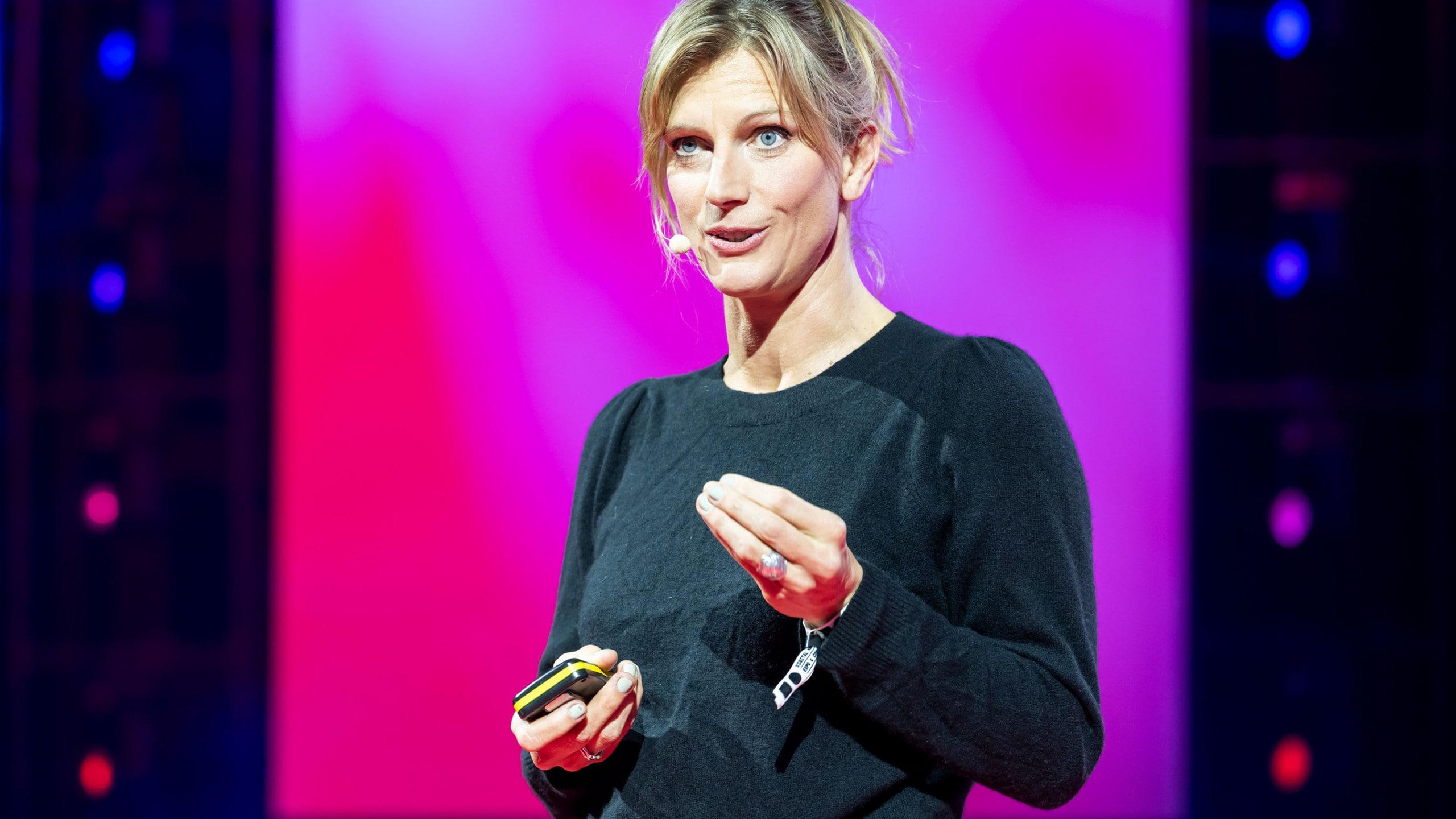
On the Center Stage at HANNOVER MESSE 2027, Dr. Maja Göpel, professor of sustainability transformation at Leuphana University Lüneburg, will discuss how the economy and society must change so that transformation, innovation, and competitiveness go hand in hand. She answers some initial questions in this interview.
Europe’s industry is under considerable pressure: From high energy and resource costs to geopolitical dependencies, there are numerous challenges. Where must Europe focus its efforts now to secure its industrial competitiveness in the long term?
“In principle, with the Green Deal, Europe has already established a very solid foundation of knowledge and strategic cooperation across policy areas. After all, even if this tends to get overlooked in the debate over ‘green versus economic efficiency,’ the vision behind the Green Deal is to be the first climate-neutral continent with a circular economy. This is accompanied by goals, visions for the future, and concrete, justifiable needs for change, which are then politically supported, promoted, or even subsidized. In research, this is called the “Whole-of-Government Approach,” and it represents the gold standard of implementation strategies. Without this holistic view of impact, certain policy instruments or privileges—depending on the government’s preferences—may persist, completely undermining the goals or even counteracting other measures; we can see this clearly in Germany through the example of environmentally harmful subsidies. I can understand the criticism that the design of the implementation measures has become too fragmented and requires too much reporting, and the Commission has responded to this. Mario Draghi’s strategies for competitiveness through decarbonization and Enrico Letta’s strategies for further integrating the European single market—with its strong purchasing power and vast potential for cooperation—have also set broad guidelines here that can serve as a framework for simplification. Simplification, however, does not mean deregulation, and here, with an irresponsible eagerness, people are throwing the baby out with the bathwater. As if there were no connections between security of supply in the purely economic sense and the question of where food, water, fuels, and resources are supposed to come from in the future—and how we should manage our reserves sensibly.”
Resilience and sovereignty have become key concepts in industrial policy. What does industrial resilience mean to you, specifically?
“For me, Canadian Prime Minister Mark Carney is the one who has consistently articulated resilience strategies, and at the European Commission, it is the State of the Union address where these broader strategic guidelines come to the fore. A sovereign nation “has to be able to feed, fuel, and defend itself”—that is, it must be able to provide for its own food, energy, and defense. That is the absolute minimum requirement, as the Canadian Prime Minister put it in the context of the EU-Canada talks in the fall of 2026. Added to this today—as also stated in the EU-Canada Declaration on the Alliance for the Future—are digital financial instruments and digital infrastructure. We are thinking of the U.S. government’s control over SWIFT and how it uses this to suddenly block the credit cards of unwelcome judges at the International Criminal Court, or how sensitive industrial data is not secure on U.S. servers due to the U.S. Cloud Act. It is high time that the public debate makes clear just how closely so-called private-sector founders—from Palantir to Starlink to PayPal to the major AI companies—have become part of an autocratic project aimed at stripping Europe of its sovereignty. This is also officially stated in the National Security Strategy, and with a large Democratic majority in the U.S. Congress starting in January 2027, there is a chance to put the first brakes on this new dimension of kleptocracy. Nevertheless, the discussion here primarily centers on risks to stock market values and the pace of innovation posed by “impending” regulation, even though the National Security Strategy and the Trump administration’s multimillion-dollar funding programs also call for targeted influence on public opinion and support for right-wing populists in European elections. These geopolitical considerations must be taken into account in the discussion of economic efficiency and growth, for it is by no means a secondary matter whose money finances future infrastructure—and under what conditions—thereby guaranteeing influence. This is why the idea behind the Alliance of Middle Powers—which Mark Carney had already proposed in January 2025—is so relevant: no single smaller country can achieve sovereignty through isolation, but only by forming a forest—as he put it—of multiple trees that can withstand storms through both their root systems and their canopies. This is also what lies behind the concept of resilience: remaining flexible, and organizing vital critical resources and infrastructural functions through close partnerships with actors who uphold values such as democracy, the rule of law, reliable rules, and sustainability. There is still a great deal of potential to be tapped within Europe itself if member states support one another more courageously in the spirit of solidarity and resilience and do not allow themselves to be intimidated by the nationalist rhetoric stoked by right-wing populists. Nationalism can only be a potential strength for very large countries with vast quantities of their own resources—and Germany, as a country with very few resources and limited energy supplies, does not fall into that category.”
Competitiveness and sustainability are often discussed as conflicting goals. How can we successfully combine the two and turn sustainability into a competitive advantage for European industry?
“It is absolutely crucial to reconnect monetary values with real values. In economic theory, one is a flow variable—meaning it merely indicates the sums of money that have moved from one place to another—and the other is a stock variable, which shows how much of a resource, a good, or even human labor or digital services is available. Unfortunately, quantitative and qualitative changes in stock are once again largely ignored in today’s debate on competitiveness, with the comparative price advantage being interpreted as a supposed strength: allowing the sell-off of nature and suspending payments for CO2 emissions—as the Trump administration does, for example—can, of course, make production cheaper in the short term, thus externalizing the real costs of this economic activity so that they are not reflected in the price. This is precisely why Trump, conversely, also talks about wanting to annex Greenland: at some point, even the United States’ treasure trove of resources will run out, and the collateral damage to the population will become apparent—as is already evident in the bipartisan protests against local water shortages and air pollution caused by the radical expansion of data centers. That is why we must first discuss the societal developments toward which an economy should even be competitive—in other words, the rules of the game by which we compete. I am very glad that Europe has so far remained steadfast and insists that the formula for competitiveness in democratic societies should not be based on short-term stock market values and insider trading, but rather on striving for long-term prosperity for as many people as possible through resource-conserving and low-pollution economic practices, grounded in social and market-based principles. After all, once groundwater reserves are depleted and infrastructure is destroyed every year by extreme weather events, even a stock market rally will no longer be able to ensure security of supply. That is why we have been debating intensively for 50 years now that the costs of economic activity must also be internalized in prices and balance sheets in order to steer market forces, innovation processes, and the digital revolution toward the best—that is, the most resource-efficient—solutions. Given the Trump administration’s blackmailing behavior and the sheer size of transnational corporations today, this is naturally more difficult than it was 4–5 years ago, but it remains the only realistic way out of a spiral of escalation in the struggle for resources. If successful, this approach will also foster the development of tomorrow’s export hits and strengthen the resilience of nations, making peace more likely. It is therefore important not to equate the competitiveness of individual companies with that of entire countries or regions, nor to confuse short-term profits with long-term sustainable solutions. We must therefore not give in to a discourse that is slipping both normatively and mathematically, but rather defend “high-road” competitiveness using data and metrics grounded in reality, and turn external threats into opportunities through a European leap forward in pooling expertise, resources, research, and innovation—including through bold further integration of policy and standards. This will also restore pride in our strength and capacity to act.”
When we look back in 2030: What course must policymakers and industry set today so that we can say then that Europe has become industrially stronger, more resilient, and better prepared for the future?
“In addition to consistent political integration and the development of institutions among the middle powers with a multilateral outlook, we need a European land registry that classifies land based on the forms of natural capital stored within it or growing on it, how these assets should be valued in light of dwindling resource stocks, and which financial instruments enable investment in nature as critical infrastructure. This has long been practiced by the Asian Infrastructure Investment Bank, for example, and is also enshrined in the European Nature Restoration Law. Industrial and financial policy must recognize the financial dimensions of ecosystem services and make them renewable. To this end, Europe’s path to digitalization should once again be consistently conceived as a “Twin Transition”—that is, all new technological possibilities should be applied to ensure resource-efficient and climate-friendly security of supply. Finally, it is imperative that we protect the space for public debate, as well as the knowledge bases and intellectual property of media organizations and scientists operating with integrity, from theft and manipulation by the major tech corporations from the U.S. On the one hand, it has long been expected that, in the medium term, these companies’ business models will resell the collected data and knowledge as proprietary services; on the other hand, we are still debating individual applications or models and whether sufficient evidence of manipulation or addictive behavior can be found to justify “bans.” The New York Times has calculated why we should be talking here about protective measures to safeguard the free formation of knowledge and opinion as well as free-market competition—especially since the major tech corporations have poured so much capital into the AI gamble that they will only ever be able to turn a profit if large segments of society become dependent on their offerings. The strategies and visions for the future of the founders of these technology companies should therefore carry more weight in the discussion than the many threats about what would happen in the event of regulation. Europe still has the opportunity to create space for other competitors through clear rules and to offer support through “Buy European” measures, similar to what has long been standard practice in China and the U.S. The processes of shaping public knowledge and opinion, in particular, should not be left to the opaque algorithms of a few wealthy men with autocratic ambitions. Or have we allowed the press to be controlled from the outside in the past?”
At the Center Stage of HANNOVER MESSE 2027, diverse perspectives from business, science, and politics come together. What makes this exchange particularly important right now—and what debates should the industry be having there?
“Bringing together different perspectives is absolutely crucial today so that we can shift our focus away from the grind of day-to-day business and back to the big, unifying issues—and so that, through direct interaction, common ground, synergies, and opportunities for learning can once again come to light—aspects that are far too rarely visible in a public discourse marked by negativity and a tendency toward confrontation. I hope that it will become clear in many contexts how the individual components from various providers can, when combined, form a shared vision for Germany’s position in Europe—including what life is like here when transformation is successful and what values we build upon in the process.”