
Record Capital with a Skew
In 2026, robotics companies are raising more venture capital than ever before. However, the money is concentrated in a few large funding rounds, and Agility Robotics’ IPO shows how quickly valuations are measured against revenue. For users, the financial strength of providers is becoming a key selection criterion.
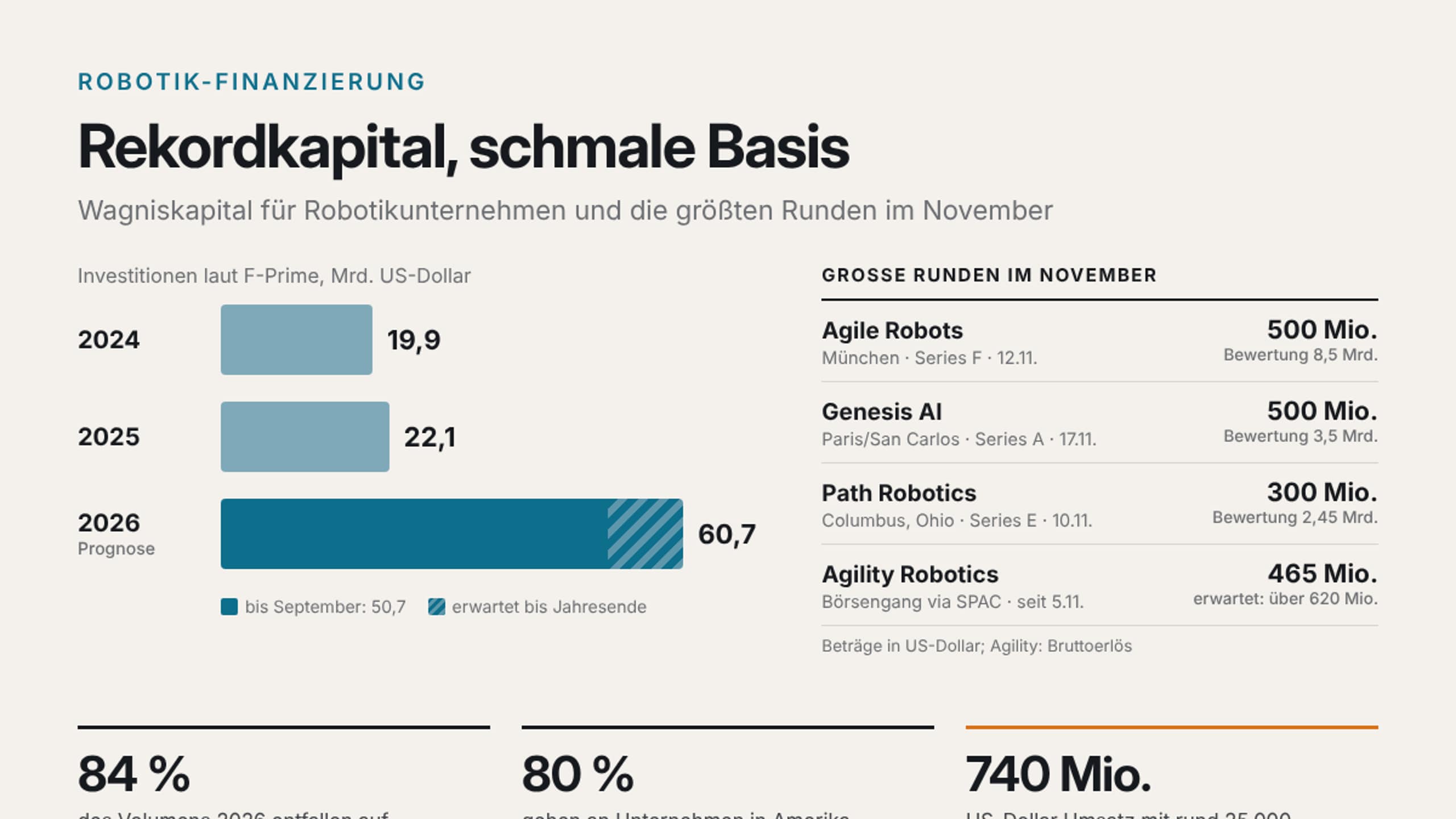
The venture capital firm F-Prime Capital reports new record highs in its “State of Robotics 2026” report. According to the report, $50.7 billion had flowed into robotics companies by the end of September; for the full year, F-Prime expects $60.7 billion—nearly triple the $22.1 billion from the previous record year, 2025.
A Record in Few Hands
However, the distribution is skewed: About 84 percent of the volume comes from mega-rounds, and about 80 percent goes to companies in the U.S. So far, this capital has been matched by modest revenue. Based on IDC figures, F-Prime estimates that approximately 25,000 humanoid robots were shipped worldwide in the first half of 2026, generating revenue of about $740 million. The authors summarize the situation matter-of-factly: “Revenue is the gravity of startups. Today’s overpriced funding rounds will eventually come back down to earth.”
Agility: An IPO with Both Feet on the Ground
Agility Robotics is experiencing just how quickly that moment can arrive. The manufacturer of the Digit humanoid went public through a merger with the special-purpose acquisition company (SPAC) Churchill Capital Corp XI. Its shareholders approved the deal on November 2 with more than 84 percent of the votes cast; the stock has been trading under the ticker symbol AGLT since November 5. It opened at $11.26, above the reference price of $10.
However, the capital inflows fell short of expectations. After redemptions, approximately $164 million remained in the trust fund; this was supplemented by a private placement led by Foxconn totaling $201 million and additional financing of $100 million. Gross, this amounts to approximately $465 million instead of the previously expected more than $620 million. On November 24, the stock closed at just under $5.40. Analysts at TD Cowen nevertheless recommend buying the stock, with a price target of $15.
Europe Makes a Big Impact
In Europe, Agile Robots led the most recent major funding round. On November 12, the Munich-based company raised $500 million in a Series F round led by SoftBank, with participation from NVIDIA, Hitachi, and T.Capital; the company is now valued at $8.5 billion. In total, Agile Robots has now raised approximately $2 billion. The company employs more than 3,500 people, has reportedly delivered over 20,000 solutions, and is establishing a manufacturing facility for humanoid robots in Munich: Approximately 2,000 units are planned for 2026, with capacity set to grow to up to 10,000 per year.
Five days later, Genesis AI, based in Paris and San Carlos, announced a Series A round of $500 million at a valuation of $3.5 billion, 16 months after a seed round of $105 million. The round was led by Premji Invest, Khosla Ventures, and Eclipse; participants include NVIDIA, AMD Ventures, and Bpifrance, among others. Genesis develops AI models for various types of robots as well as the general-purpose robot Eno, initially for manufacturing and logistics. According to Tech.eu, which also counts drone manufacturers as part of the robotics sector, European companies in the industry had raised 3.7 billion euros in equity across 59 funding rounds by early November, with NEURA Robotics accounting for 1.2 billion of that amount alone. The two November rounds are not yet included in this figure.
Where Capital Meets Applications
Path Robotics demonstrates that investors don’t just reward promises of general-purpose applications. The Columbus, Ohio-based company uses AI to automate welding and closed a Series E round of $300 million on November 10, led by Georgian. The company’s valuation stands at $2.45 billion and, according to Bloomberg, has nearly quadrupled. Path aims to expand beyond welding into other manufacturing steps and types of robots. Earlier this year, the shipbuilding group HII had already signed a performance-based production agreement with Path for U.S. naval shipbuilding.
Financial Strength as a Selection Criterion
For users, the concentration of capital has two sides. Well-financed providers can sustain manufacturing, service, and further development for years. At the same time, many valuations are based on expectations rather than revenue; if the market corrects them, product roadmaps and support commitments come under pressure. When making procurement decisions, it is therefore worth looking at a provider’s financing history, customer base, and liquidity range—as well as contract models such as Robot-as-a-Service, which leave part of the risk with the provider.